Sound familiar?Toronto
- The call
- After the fit-out, the gym floor now holds more people than the old office space ever did, and the exit door at the back still has the same turn-lock it had when the room held desks.
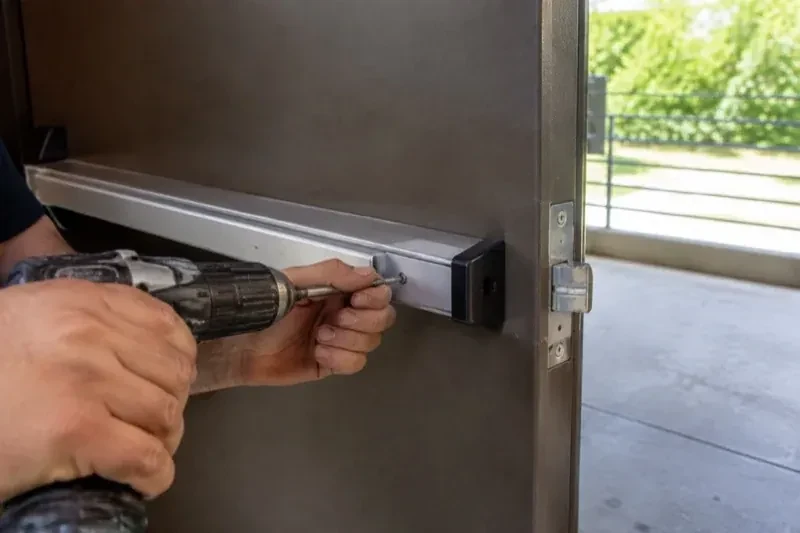
The crossbar on the loading-dock door barely returns anymore. Someone has to lean into it with a shoulder, and twice this month it has stuck half-latched, propped by whatever was nearest.
A pair of doors is its own small project, and not every pair needs the same approach. Some rim-device pairs keep their mullion and latch each leaf independently with no set closing order. Where sequencing does matter, one leaf is chosen as the inactive leaf and closes first, guided by a coordinator so the active leaf's device can seat properly into the strike or into an astragal on the inactive leaf. Removing a centre mullion calls for a compatible replacement arrangement on each leaf, which can matter for wheelchair access or for moving equipment through.
Sound familiar?Toronto
Panic & Exit Hardware · Toronto
Scene 1
When a card reader, keypad or intercom is part of the plan, the assessment includes a conversation about the exit side of the same door: does the reader need a request-to-exit signal so the panel knows someone left rather than forced the door, and does the door need electric latch retraction so it can be released remotely without ever compromising the crossbar's push-to-exit function. These questions are answered before the device is ordered, because retrofitting an electrified function onto hardware chosen without it in mind rarely goes cleanly.
Scene 2
Where the plan includes access control or an alarm, the wiring is run and terminated to the device without touching its mechanical exit function: a request-to-exit switch reports that the pushpad or crossbar was actuated, electric latch retraction lets an authorized signal release the latch for entry, and an alarm module sounds locally when the crossbar is used. On a fire-rated opening, electric latch retraction is arranged to relatch automatically the instant a fire-alarm signal comes in, since a fire door has to keep its active latch and cannot rely on a mechanical dogging function to do that.
Scene 3
The building keeps full control over who enters through the trim on the outside of the door, independent of what happens on the inside. A lost key, a staff change or a new access-control card affects only the entry side; the exit side keeps working exactly as it did on installation day. That separation is the point of the whole installation, and it is worth remembering when any future change is proposed for that door, so entry security is never solved by touching the inside crossbar.
What shapes the quoteNorth Park Locksmith Co.
FeesSame any hour
A rim device sits on the surface of the door and suits most single openings, including many tall and fire-rated doors on their own. A mortise device fits into a pocket cut in the door's edge and is chosen where a heavier case or a particular trim style is wanted. A vertical-rod device runs rods to the top, or top and bottom, of the frame, which suits an opening that specifically needs latching at more than one point rather than height by itself.
The device and trim choices are the same, but a retrofit usually has to work with a door and frame that already carry someone else's old hardware preparation. Reading what holes and reinforcement already exist, and choosing a device that can use or cleanly replace them, is a bigger part of a retrofit than of a new opening built with the hardware in mind from the start.
Exit-device makers publish a mounting range for their own models, and in practice a crossbar or touchpad sits no higher than about 1200 mm above the finished floor. The locksmith sets the hardware inside the maker's range and below that ceiling, allowing for anyone in the space who needs a lower reach, a wheelchair user or a shorter staff member among them.
TorontoOntario
Panic & Exit Hardware · Downsview, North Park
Every square is one home in a hundred.
On-site assessment
The crossbar on the loading-dock door barely returns anymore.
(289) 536-9733, open 24/7.
On-site assessment preferred · (289) 536-9733, open 24/7